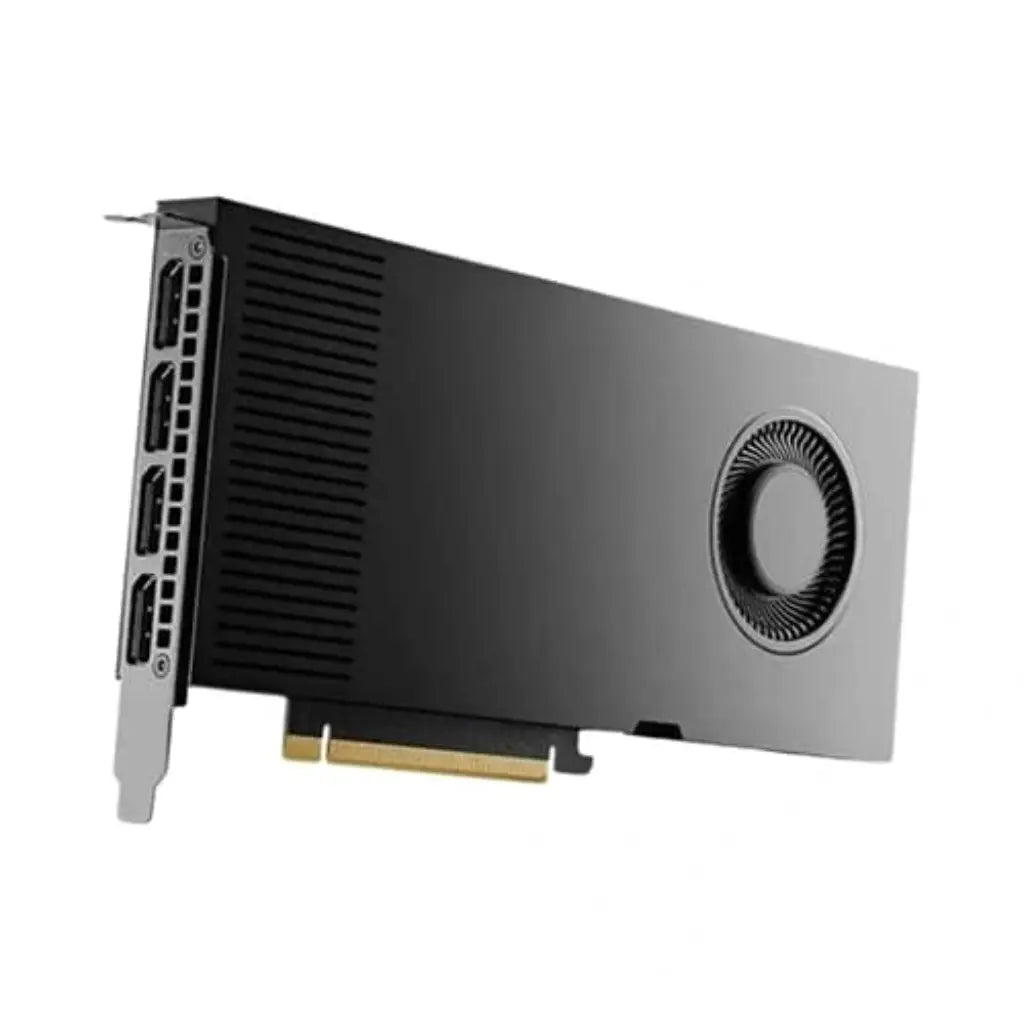
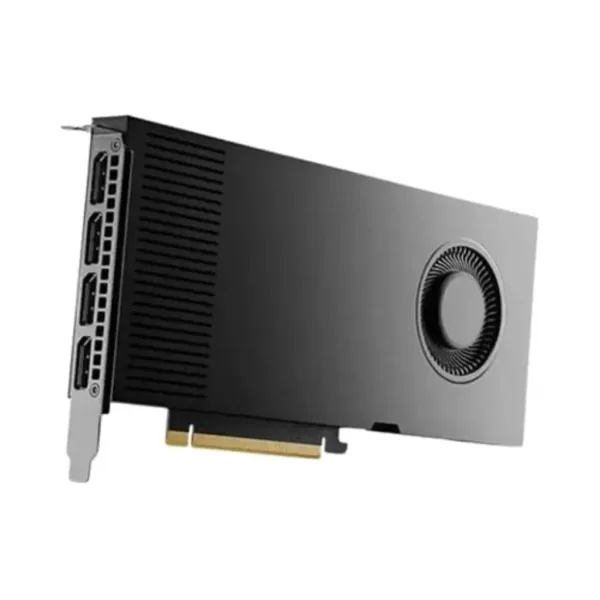
The NVIDIA RTX 4000 Ada Generation is a professional workstation graphics card designed for CAD, 3D modelling, engineering visualization, rendering, AI inference, content creation and GPU-accelerated computing. Built on NVIDIA’s Ada Lovelace architecture, it combines 6,144 CUDA cores, 192 fourth-generation Tensor Cores and 48 third-generation RT Cores with 20GB of GDDR6 memory with ECC.
The card is particularly useful where a workstation needs professional graphics acceleration without moving to a larger dual-slot GPU. Its single-slot design, 130W maximum board power and PCIe Gen4 x16 interface make it suitable for a wide range of professional tower workstations. NVIDIA specifies four DisplayPort 1.4a outputs and support for up to four displays under supported configurations.
For engineering and design teams in Delhi NCR, Bengaluru, Hyderabad, Pune and other technology centres, the RTX 4000 Ada can serve as the graphics accelerator for CAD assemblies, 3D visualization, professional rendering and GPU-enabled technical applications. The 20GB ECC-protected graphics memory also provides useful capacity for larger scenes, models and datasets.
If the requirement is for a complete workstation rather than a standalone GPU, the HP Z2 Tower G1i workstation with RTX 4000 Ada is an example of a compatible professional workstation configuration.
Key Features
- NVIDIA Ada Lovelace architecture.
- 6,144 NVIDIA CUDA cores.
- 192 fourth-generation Tensor Cores.
- 48 third-generation RT Cores.
- 20GB GDDR6 graphics memory with ECC.
- 160-bit memory interface with 360GB/s memory bandwidth.
- PCIe 4.0 x16 system interface.
- Four DisplayPort 1.4a outputs.
- 130W total board power.
- Single-slot professional workstation form factor.
- Active cooling solution.
- Hardware acceleration for professional rendering, AI and compute workloads.
Why Choose the RTX 4000 Ada Generation
The RTX 4000 Ada sits in a practical part of NVIDIA’s professional graphics range for users who need substantial GPU resources without moving to a physically larger and higher-power card. The 20GB memory capacity is significant for professional workloads because complex models and high-resolution assets can consume graphics memory quickly.
For a CAD engineer, the GPU can accelerate supported 3D viewport operations. For an architect, it can be used for real-time visualization and ray-traced workflows. For a media professional, CUDA and dedicated video hardware can accelerate supported editing and encoding applications. For developers, CUDA and Tensor Cores provide a platform for supported AI and compute workloads.
The single-slot design is also important when building or upgrading a workstation. It allows the card to occupy less physical expansion space than many high-power professional graphics cards, leaving additional room for other PCIe devices where the workstation chassis and motherboard provide the necessary slots.
GPU Architecture and CUDA Processing
The RTX 4000 Ada is based on NVIDIA’s Ada Lovelace architecture. Its 6,144 CUDA cores provide the primary parallel-processing engine for CUDA-enabled applications and graphics workloads. NVIDIA specifies 26.7 TFLOPS of peak single-precision performance based on GPU Boost clock operation.
CUDA is widely used across professional rendering, engineering computation, scientific applications, AI frameworks and content-creation software. This makes the card more than a display adapter: compatible applications can use its parallel compute resources to move suitable workloads away from the CPU.
For an engineering office in Noida or Gurgaon, this can be relevant when the same workstation is used for CAD modelling during the day and rendering or other GPU-accelerated workloads later. The exact benefit depends on the software and workload rather than the GPU specification alone.
AI Processing with Tensor Cores
The card includes 192 fourth-generation Tensor Cores. These specialised processing units are designed to accelerate supported AI and matrix operations and support modern precision formats used by compatible AI software.
NVIDIA positions the RTX 4000 Ada for AI-enabled professional applications, generative AI and inference workloads. The combination of Tensor Cores and 20GB graphics memory gives developers additional local GPU resources for supported models and applications without relying exclusively on cloud-based compute.
AI developers in Bengaluru, Hyderabad and Pune can use CUDA-compatible frameworks and NVIDIA software stacks where supported. The actual model size that can be loaded locally depends on precision, framework overhead, batch size and available GPU memory.
Ray Tracing and Professional Visualization
The 48 third-generation RT Cores provide hardware acceleration for ray-tracing operations. NVIDIA specifies up to 61.8 TFLOPS of RT Core performance for the RTX 4000 Ada based on GPU Boost clock rates.
Ray tracing is useful in workflows where lighting, reflections, shadows and physically based materials need to be calculated more accurately. Architectural visualization, product design, digital content creation and virtual prototyping are examples of workloads where this hardware can be used.
A design studio working on architectural interiors can use supported rendering software to produce more realistic lighting previews, while an industrial design team can evaluate product surfaces and materials before physical prototypes are manufactured.
20GB GDDR6 ECC Graphics Memory
The RTX 4000 Ada includes 20GB of GDDR6 graphics memory with Error-Correcting Code. NVIDIA specifies a 160-bit memory interface and 360GB/s memory bandwidth.
Graphics memory is particularly important in professional workloads because large CAD assemblies, high-resolution textures, detailed 3D scenes, video projects and AI datasets can consume substantial VRAM. When the working dataset fits within GPU memory, the application can avoid repeatedly moving data between system memory and the graphics card.
ECC provides an additional layer of memory error protection for supported professional workloads. This can be relevant in environments where workstations are used for extended rendering, engineering calculations or other long-running compute tasks.
Rendering and 3D Workloads
The combination of CUDA cores, Tensor Cores and RT Cores gives the RTX 4000 Ada multiple hardware paths for modern rendering workflows. Applications that support CUDA can use the GPU’s general-purpose compute resources, while supported ray-tracing renderers can make use of the dedicated RT hardware.
NVIDIA specifically positions the card for 3D modelling and rendering workloads. The 20GB memory capacity also gives professional users more room for complex scenes and multi-application workflows.
For architecture and product-design teams, the practical advantage is the ability to move from modelling to interactive visualization and final rendering on the same workstation when the software supports GPU acceleration.
Video Encoding and Content Creation
The RTX 4000 Ada includes dedicated video encode and decode hardware, including AV1 support. NVIDIA lists two encode and two decode engines for the card.
This hardware can accelerate supported video workflows in professional applications, reducing the amount of encoding work that needs to be performed exclusively by the CPU. Video professionals working with high-resolution footage can therefore benefit from GPU-assisted encoding, decoding and effects processing where their application supports the relevant NVIDIA acceleration paths.
For production environments in Mumbai, Bengaluru, Delhi and Hyderabad, this can be useful when a workstation is used for editing, motion graphics, compositing and export rather than being dedicated exclusively to CAD or engineering work.
Display and Multi-Monitor Capability
The card provides four DisplayPort 1.4a outputs. NVIDIA specifies support for up to four 4096 × 2160 displays at 120Hz or four 5120 × 2880 displays at 60Hz under supported configurations. It also supports two 7680 × 4320 displays at 60Hz.
Multi-monitor support is useful for professional desks where the user needs a main CAD or 3D viewport alongside drawings, documentation, reference material and communication applications.
A financial modelling, engineering or content-production workstation can similarly use multiple displays to separate the primary application from supporting windows. The final display configuration should always be checked against the monitor interfaces, resolutions and refresh rates being deployed.
PCIe Interface and Workstation Integration
The RTX 4000 Ada uses a PCIe Gen4 x16 interface. This provides a high-bandwidth connection between the GPU and the workstation platform. The card has a single-slot form factor measuring approximately 4.4 inches in height and 9.5 inches in length.
The compact single-slot design can be valuable when upgrading professional tower workstations where PCIe slot availability is limited. It can leave physical space for additional storage controllers, networking cards or other expansion hardware depending on the workstation motherboard and chassis.
Before installing the GPU into an existing workstation, buyers should verify physical clearance, power connectors, BIOS compatibility and the manufacturer’s supported GPU list. Thencix can verify the intended workstation configuration before supplying the card.
Power and Thermal Design
NVIDIA specifies a total board power of 130W for the RTX 4000 Ada. The card uses an active thermal solution and is designed as a single-slot professional graphics board.
The relatively controlled power requirement makes the card practical for professional workstation designs where power consumption and chassis space need to be considered alongside graphics performance.
Workstation airflow remains important. The graphics card should be installed in a chassis with adequate ventilation, and the system should be maintained in accordance with the workstation manufacturer’s thermal and installation requirements, particularly in Indian environments where ambient temperatures can rise considerably during summer.
Professional Application Compatibility
The RTX 4000 Ada is intended for professional applications across design, engineering, visualization, rendering, AI and content creation. NVIDIA’s professional graphics portfolio is built around ISV-tested workstation workflows and professional application support.
Typical software categories include CAD and CAE applications, architectural visualization, 3D modelling, GPU rendering, video production, AI development and technical computing. Examples can include Autodesk applications, Dassault Systèmes software, Adobe applications, Blender and other CUDA- or RTX-enabled applications where the particular software version supports the GPU.
Application performance should always be evaluated against the actual project workload. A graphics card that performs well for 3D visualization may behave differently in a CPU-heavy simulation, while an AI workload may depend more heavily on model size and VRAM requirements.
Professional Workload Applications
CAD and Engineering
The RTX 4000 Ada can accelerate supported 3D CAD and CAE workloads through its CUDA and professional graphics architecture. Engineering teams working on mechanical assemblies, product development or technical visualization can use the GPU for supported viewport and rendering operations.
Architecture and BIM Visualization
Architectural practices can use the card for 3D visualization, real-time walkthroughs and supported ray-traced rendering. The 20GB graphics memory provides additional headroom for detailed models and high-resolution assets.
Product Design
Industrial designers can use the GPU for interactive modelling, visualization and photorealistic rendering of product concepts. Ray-tracing hardware is particularly useful where realistic lighting and material evaluation form part of the design process.
Media and Content Creation
Video editors, motion-graphics artists and 3D content teams can take advantage of CUDA acceleration, dedicated encoding hardware and RTX features in supported applications.
AI and Data Science
Developers can use CUDA and Tensor Cores for compatible machine-learning and inference workloads. The 20GB ECC graphics memory gives the card a substantial local memory pool for supported models and datasets.
Technical Specifications
| Specification |
Details |
| Brand |
NVIDIA |
| Product |
RTX 4000 Ada Generation |
| Model |
RTX-4000-ADA |
| Part Number |
900-5G190-2570-000 |
| Architecture |
NVIDIA Ada Lovelace |
| CUDA Cores |
6,144 |
| Tensor Cores |
192, 4th Generation |
| RT Cores |
48, 3rd Generation |
| Graphics Memory |
20GB GDDR6 ECC |
| Memory Interface |
160-bit |
| Memory Bandwidth |
360GB/s |
| System Interface |
PCIe 4.0 x16 |
| Display Outputs |
4 × DisplayPort 1.4a |
| Maximum Board Power |
130W |
| Thermal Solution |
Active |
| Form Factor |
Single Slot |
| Dimensions |
4.4″ H × 9.5″ L |
| Video Engines |
2 × Encode, 2 × Decode, AV1 support |
| Graphics APIs |
DirectX 12, OpenGL 4.6, Vulkan 1.3 |
| Compute APIs |
CUDA, OpenCL, DirectCompute |
| VR Ready |
Yes |
Package Contents
- NVIDIA RTX 4000 Ada Generation graphics card.
- Standard manufacturer packaging and documentation, subject to supplied retail or channel package configuration.
- Display adapters or additional power accessories should be confirmed against the supplied package before order.
- Workstation, monitor, operating system and additional PCIe accessories are not included unless specifically mentioned in the quotation.
If the card is being purchased as an upgrade, the workstation model should be provided before ordering so power, physical clearance, PCIe slot arrangement and manufacturer compatibility can be checked.
Why Buy From Thencix
Thencix supplies professional workstation components and complete workstation configurations from Nehru Place, Delhi. For a professional GPU such as the RTX 4000 Ada, confirming the exact model, memory capacity and workstation compatibility before dispatch is important, particularly when the card is being added to an existing production system.
The purchase is supplied with a GST invoice for business procurement and accounting. Buyers in Delhi NCR can also discuss workstation integration, RAM and storage requirements or complete system configurations with the Thencix team.
For current availability, compatibility confirmation, bulk requirements or quotation support, contact Thencix on WhatsApp at +91 9891150949 or email [[email protected]](mailto:[email protected]).
Thencix is located at 109B Osian Building, 12 Nehru Place, Delhi 110019.
Comparison With Similar Professional GPUs
| GPU |
Architecture |
Graphics Memory |
Primary Positioning |
| NVIDIA RTX 4000 Ada |
Ada Lovelace |
20GB GDDR6 ECC |
Professional CAD, visualization, rendering, AI and compute |
| NVIDIA RTX 4000 SFF Ada |
Ada Lovelace |
20GB GDDR6 ECC |
Professional graphics for compact workstations |
| NVIDIA RTX 4500 Ada |
Ada Lovelace |
24GB GDDR6 ECC |
Higher graphics and compute requirements |
| NVIDIA RTX 2000 Ada |
Ada Lovelace |
16GB GDDR6 ECC |
Lower-power professional workstation graphics |
The RTX 4000 Ada is distinct from the RTX 4000 SFF Ada despite sharing the RTX 4000 name. The standard RTX 4000 Ada is a single-slot full-size professional card with 130W board power, while the SFF version is designed for compact systems and has a substantially lower 70W power rating. Buyers should therefore verify the exact GPU before purchasing for a workstation.
For a complete professional workstation with a newer-generation professional graphics architecture, the HP Z4 G5 RTX PRO workstation provides a different platform and GPU generation for comparison.
Frequently Asked Questions
What is the NVIDIA RTX 4000 Ada Generation used for
The RTX 4000 Ada is designed for professional CAD, 3D modelling, rendering, visualization, AI inference, content creation and GPU-accelerated technical computing.
How much VRAM does the RTX 4000 Ada have
The card has 20GB of GDDR6 graphics memory with ECC. NVIDIA specifies a 160-bit memory interface and 360GB/s memory bandwidth.
How many CUDA cores does the RTX 4000 Ada have
The RTX 4000 Ada has 6,144 CUDA cores based on NVIDIA’s Ada Lovelace architecture.
Does the RTX 4000 Ada support ray tracing
Yes. It includes 48 third-generation RT Cores designed to accelerate supported ray-tracing workloads.
Is the RTX 4000 Ada suitable for AI
Yes. The GPU includes 192 fourth-generation Tensor Cores and 20GB of graphics memory, providing hardware acceleration for supported AI and inference applications.
How many monitors can the card support
The card has four DisplayPort 1.4a outputs. NVIDIA specifies support for up to four displays under supported resolution and refresh-rate configurations.
Is this the RTX 4000 SFF Ada
No. This listing is for the standard RTX 4000 Ada Generation. The SFF version is a separate product with a different physical design and 70W board power.
What power consumption should be considered
NVIDIA specifies a total board power of 130W for the RTX 4000 Ada. The complete workstation power requirement will depend on the processor, motherboard, storage, cooling and other installed components.
Can this GPU be installed in any desktop
Installation should be checked against the workstation manufacturer’s specifications. PCIe slot availability, physical clearance, power delivery, BIOS support and chassis airflow should all be confirmed before installation.
Is the RTX 4000 Ada suitable for CAD and engineering
Yes. NVIDIA positions the card for professional design and engineering workloads, including complex 3D CAD and CAE workflows.
Can Thencix supply the GPU with a workstation
Yes. Thencix can quote the RTX 4000 Ada as a standalone graphics card or as part of a complete workstation configuration. Contact WhatsApp +91 9891150949 for configuration and compatibility assistance.
Is warranty included with the graphics card
The exact warranty term for the standalone graphics card should be confirmed against the supplier invoice and supplied warranty documentation before order. The manufacturer specification confirms the product and technical configuration but does not establish a Thencix-specific warranty period.
For current availability, workstation compatibility, bulk procurement or a complete system quotation, contact Thencix at +91 9891150949.
 Skip to navigation
Skip to main content
Skip to navigation
Skip to main content




 Free Delivery










Reviews
Clear filtersThere are no reviews yet.